
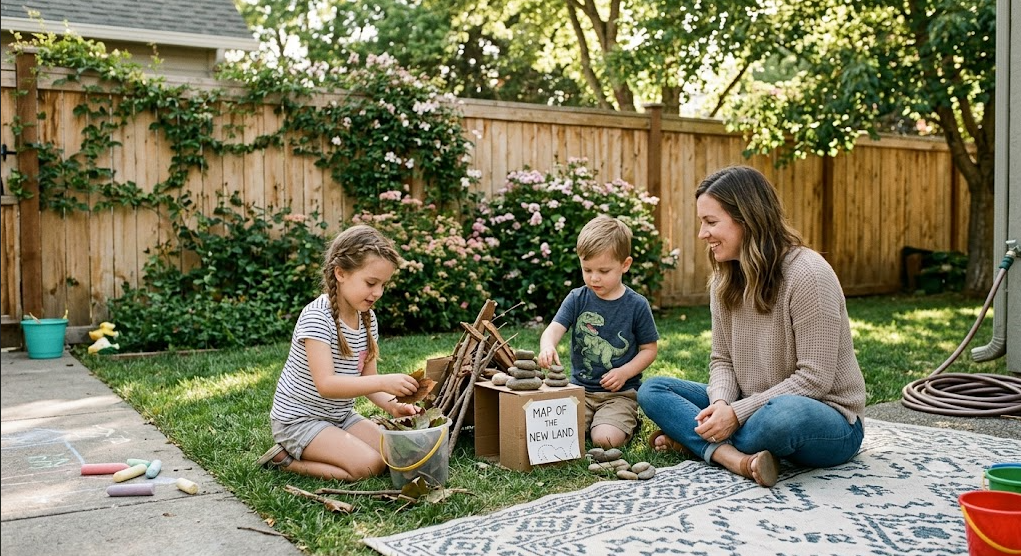
Your kids were somehow bored five minutes after asking to go outside, and now they are standing at the back door like your yard has personally failed them. That is usually the moment parents assume they need a park trip, a big craft, or a full day plan. Most of the time, they do not. A backyard can feel brand new again with the right kind of invitation.
A lot of kids do not really want “outside.” They want a mission. They want a reason to run, collect, build, hide, discover, and report back like something important is happening. That is why a plain yard can feel boring one day and magical the next. The difference is usually not space or money. It is whether the activity gives kids something to do.
That is good news for tired parents. You do not need to build a Pinterest-worthy obstacle course or buy expensive outdoor gear. You need a few repeatable ideas that work on regular afternoons and keep setup simple.
Why This Happens
Kids are often more engaged when play has a story, challenge, or clear job built into it. “Go play outside” is too open-ended for a lot of children, especially if they are used to screens, structured activities, or adults setting the pace. They may want movement, but still need a spark to get started.
Backyards help because they are familiar enough to feel safe and flexible enough to become almost anything. A patch of grass can turn into a safari, a racetrack, a dig site, a fairy village, or a science lab depending on what idea lands first. That combination matters. If your child tends to calm down and cooperate more after moving, you may notice overlap with why physical activity matters for kids.
Another reason backyard play works is that it reduces transition friction. A big outing means packing snacks, finding shoes, loading the car, and managing everybody’s expectations. Backyard adventures keep the barrier low, which makes them easier to say yes to on ordinary days.
What Parents Can Do
Give the activity a mission, not just a location
Instead of saying, “Go outside,” try giving kids a purpose. Missions work because they create instant momentum. Try things like:
- “Find five things in the yard that feel different.”
- “Build a tiny animal house using only sticks, leaves, and rocks.”
- “Pretend the yard is unexplored land and map it.”
- “Create an obstacle course and teach me the rules.”
A mission gives kids a starting point without controlling every detail. Once they begin, their own ideas usually take over. If your family likes this kind of challenge-based play, family challenges for fun has more ideas that tap into the same energy.
Use what is already in the yard
Parents sometimes assume outside fun requires new equipment. It usually does not. Buckets, sticks, sidewalk chalk, plastic cups, cardboard, and a garden hose can do a surprising amount of heavy lifting.
- Chalk becomes a racetrack, hop path, target zone, or giant board game.
- Sticks and leaves become building materials for nests, forts, or signs.
- Plastic cups become bowling pins, bug-viewing containers, or water relay tools.
- Cardboard becomes a signpost, treasure chest, or nature journal backing.
Keep one or two go-to adventures on repeat
You do not need fresh genius every afternoon. In fact, kids often enjoy repeat adventures more than adults do because repetition helps them deepen the game. A child who loved a bug hunt on Monday may want to create a full “insect rescue station” on Wednesday. The second version is often better because they already know the world they are building.
Good repeatable backyard ideas include treasure hunts, water relays, nature scavenger hunts, mini Olympics, pretend camping, and build-your-own forts. If your yard play tends to lose steam after ten minutes, this article on family bonding activities can help you think about which kinds of shared play hold your kids’ attention longer.
Let boredom sit for a minute before you rescue it
This part is hard. When children complain they are bored, parents often rush to entertain them before the whining spreads. But a little boredom is often the bridge to better play. Kids sometimes need a few slow minutes to grumble, wander, poke at the dirt, and then come up with something better than the adult would have suggested anyway.
That does not mean ignoring them indefinitely. It means resisting the urge to over-direct. You can offer one prompt like, “Do you want a building mission or a searching mission?” Then step back. A little space can do more than a long list of ideas.
Mix movement with imagination
The best backyard adventures usually combine physical movement with a pretend layer. Running laps is fine. Running laps because you are delivering medicine to the dragon village is better. Digging in the dirt is nice. Digging because you are searching for buried fossils is much more interesting.
This is especially useful for kids who are reluctant to try outdoor play but love stories, pretend games, or collecting things. A simple scavenger hunt can help because it gives children something concrete to look for while still leaving room for imagination. If that would fit your family, scavenger hunt cards can be a handy optional tool for jump-starting outdoor play without much prep.
Build in an easy win for the parent too
Backyard adventures are more likely to happen regularly if they do not drain you. Pick ideas that match your actual energy level. Some days you may want to join the game. Other days your goal is drinking coffee on the patio while supervising a chalk mission from six feet away. Both count.
It also helps to set out a small “outside bin” with a few reliable items: chalk, cups, a ball, string, a magnifying glass, and a towel. Easy access matters. When kids can grab what they need without asking you for six things, the activity starts faster and lasts longer.
Common Mistakes to Avoid
Making the setup bigger than the play
If every backyard activity requires a supply run, a long cleanup, or a perfect weather window, you will stop doing it. Simple beats impressive almost every time.
Directing the game too much
Adults often accidentally turn play into instructions. If your child starts with your idea and then changes it completely, that is not failure. That is usually where the good part starts.
Expecting siblings to enjoy the exact same adventure
One child may want to build a fairy village while another wants to sprint in circles with a foam airplane. That does not mean the afternoon is ruined. Shared outdoor time does not always need one unified activity.
Using backyard play only as a backup plan
Kids can sense when outside time is treated like the lesser option after “real fun” falls through. If you present backyard adventures like something worth doing in their own right, children tend to buy in more easily.
Simple Plan to Try This Week
If you want backyard play to happen more often without making it another job, try this for one week:
Day 1: Make a tiny outside kit
Fill a bin or bag with chalk, cups, a ball, string, paper, tape, and one towel. Use what you already have.
Day 2: Offer two missions
Instead of asking an open question, say, “Do you want to build something or search for something?” Let your child choose.
Day 3: Repeat the winning idea
If yesterday’s game worked, do not reinvent it. Bring it back and let your child expand it.
Day 4: Add one nature element
Ask your child to collect leaves, rocks, petals, or sticks for part of the game. Natural materials make the yard feel more alive and less staged.
Day 5: Try a parent-light activity
Set up something simple like chalk targets, a relay with cups, or a hunt for “tiny treasures” so the kids can carry most of the play themselves.
Day 6: Stretch the adventure into evening
Backyard play can feel brand new at a different time of day. Try bubbles at sunset, flashlight tag, or a blanket picnic after dinner. If your family likes making ordinary moments feel special, family traditions worth starting has ideas that can turn simple routines into something kids remember.
Day 7: Notice what your child naturally returns to
That is your clue for what kind of outside play fits them best. Some kids love collecting. Some love speed. Some love pretend worlds. Follow that pattern next week.
Helpful Tools
You do not need to buy anything to make a backyard feel more fun, but a couple of optional tools can make outdoor play easier when your idea bank is running low:
- Scavenger Hunt Cards can help kids who need a concrete mission before they settle into outdoor play.
- Family Adventure Challenge Book works well for families who want fresh outdoor prompts without having to invent a new activity every weekend.
FAQ
What if my backyard is really small?
That is fine. A small patio, side yard, or patch of grass can still work for scavenger hunts, chalk games, water play, collecting activities, pretend camping, and mini building projects. Kids usually need more imagination than square footage.
How do I get kids outside when they say it is boring?
Offer a mission instead of a general instruction. “Go outside” is easy to reject. “Can you find three things in the yard that would work for a fairy bridge?” is harder to ignore.
Do I need to participate the whole time?
No. Some backyard adventures are better when you help start them and then step back. Think of yourself as the launch button, not the full entertainment department.
What ages are backyard adventures best for?
Most of these ideas work best for preschool and elementary-age kids, but older siblings often join in if the challenge feels playful enough. The key is adjusting the mission so it does not feel babyish.
What if the kids start fighting outside too?
That can happen anywhere. Sometimes a shared mission helps because it gives everyone a role. If conflict is a regular part of play, shorter activities with clearer jobs often work better than one big open-ended setup.
Backyard adventures work best when they feel easy enough to do on a random Tuesday, not just on the days when you are operating at full energy. A little mission, a few ordinary supplies, and permission for kids to turn the yard into something bigger than it is can go a long way. And if the weather sends everybody back inside tomorrow, rainy day activities for kids is a good backup that keeps the same playful spirit going.

















Comments 0